Sheet Metal Fabrication Service from China
Rapid sheet metal prototyping and low-volume production — laser cutting, CNC bending, punching, stamping, welding, and finishing. From design to inspected parts in as few as 3 days.

Overview
What Is Sheet Metal Prototyping?
Sheet metal prototyping is a fabrication process that transforms flat metal sheets into functional parts and enclosures through cutting, bending, forming, and joining operations. Unlike CNC machining (which removes material from a solid block), sheet metal fabrication works with thin, flat stock — typically 0.5mm to 6mm thick — to create lightweight yet structurally strong components.
At KUSLA, every project follows a structured workflow: quoting → programming → cutting → punching/forming → hardware insertion → welding → surface finishing → dimensional inspection. This end-to-end process ensures precision and repeatability whether you need 1 prototype or 10,000 production parts.
Our services are ideal for engineers testing new enclosure designs, product teams validating form-fit-function before tooling investment, and manufacturers needing bridge production runs with fast turnaround.
Our Capabilities
Sheet Metal Fabrication Processes

Laser Cutting
Fiber laser cutting for clean edges and intricate profiles. Maximum sheet size 1500×3000mm, cutting accuracy ±0.05mm, thickness up to 10mm (mild steel) and 6mm (stainless/aluminum).
CNC Bending
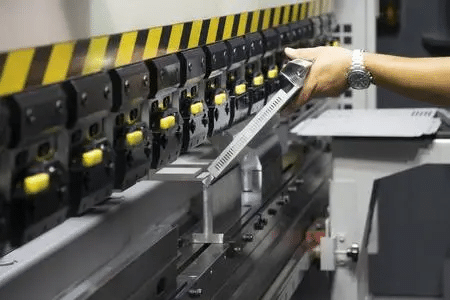
CNC press brakes with ±0.1° angular accuracy. Minimum inside bend radius equals material thickness (1T). We handle complex multi-bend parts and maintain tight dimensional control across production runs.

CNC Punching
High-speed turret punching for holes, slots, louvers, and embossing. Positional accuracy ±0.1mm. Cost-effective for repetitive hole patterns and medium-to-high volumes.

Stamping
Progressive and single-station stamping for high-volume production. We manufacture custom dies in-house. Ideal for brackets, clips, terminals, and parts requiring deep drawing or complex forming.
Technical Specifications
Tolerances, Limits & Capabilities
All sheet metal fabrication follows ISO 2768-m (medium) as default. Tighter tolerances available with 2D drawings specifying critical dimensions.
| Parameter | Capability |
|---|---|
| Sheet Thickness Range | 0.5 – 6mm (up to 10mm for laser cutting) |
| Max Sheet Size | 1500 × 3000 mm |
| Laser Cutting Tolerance | ±0.05 mm |
| Bending Tolerance | ±0.1 mm / ±0.1° |
| Punching Positional Accuracy | ±0.1 mm |
| Min Bend Radius | 1T (equal to material thickness) |
| Min Hole Diameter | Equal to material thickness (min 0.5mm) |
| Welding Types | TIG, MIG, spot welding, laser welding |
| Max Part Weight | 50 kg |
| Lead Time (Prototypes) | 3 – 5 business days |
| Lead Time (Production) | 1 – 3 weeks |


Materials
Sheet Metal Material Options
We stock a range of metals suited for prototyping and production. Our engineering team helps you select the right alloy based on your strength, corrosion resistance, weight, and cost requirements.
Need a material not listed? Contact us — we source specialty alloys on request.
Post-Processing
Surface Finishing Options
After fabrication, we apply finishing treatments to improve durability, appearance, and corrosion resistance.
- As Fabricated — Deburred edges, standard surface from cutting and bending
- Bead Blasting — Uniform matte texture using fine glass beads
- Anodizing (Type II/III) — Hard-coat or decorative anodizing for aluminum parts
- Powder Coating — Durable color finish, any RAL code, scratch-resistant
- Wet Painting — Spray-applied liquid paint for custom colors and effects
- Electroplating — Zinc, nickel, or chrome plating for corrosion protection
- Silk Screening — Printed logos, labels, and markings on enclosures
- Passivation — Chemical treatment for stainless steel corrosion resistance
Applications
What Can You Build with Sheet Metal?
Sheet metal fabrication is one of the most versatile manufacturing processes — it supports everything from one-off prototypes to production runs of thousands. Common applications include electronic enclosures, structural brackets, automotive body panels, medical device housings, and consumer appliance components.
Related services: CNC Machining · Low-Volume Manufacturing · Aluminum Machining

Our Work
Gallery of Sheet Metal Prototypes


FAQ
Frequently Asked Questions
We accept STP, IGES, DWG, DXF, PDF, and STEP files in both 2D and 3D. For accurate quoting, please include a 2D drawing specifying tolerances, material grade, surface finish, quantity, and shipping destination.
Prototypes typically ship in 3–5 business days. Low-volume production runs (100–1000+ parts) take 1–3 weeks depending on complexity, material availability, and finishing requirements. We offer expedited options for urgent projects.
No. We accept orders from 1 piece to 10,000+ units. Our processes are optimized for both rapid prototyping and bridge-to-production volumes.
We process sheets from 0.5mm to 6mm for most materials. Laser cutting can handle up to 10mm for mild steel and up to 6mm for stainless steel and aluminum. Contact us for thicker gauge requirements.
We primarily use fiber laser cutting (for precision and clean edges) and plasma cutting (for thicker plates). Waterjet cutting is available on request for heat-sensitive materials.
Simple flat parts start around $10–$50 each. Complex assemblies with welding, hardware insertion, and surface finishing typically range from $100 to $2,000+ depending on material, geometry, and quantity. Upload your CAD file for an instant quote — we respond within 24 hours.