Acrylic CNC Machining Service
Precision CNC milling and turning for cast and extruded acrylic (PMMA). We machine optically clear parts with tolerances down to ±0.01 mm, then flame-polish or vapor-polish edges to restore full transparency. Upload your CAD file for a quote within 24 hours.

How We CNC Machine Acrylic at KUSLA
Acrylic behaves differently from metals and even from other engineering plastics. It is notch-sensitive, meaning sharp internal corners concentrate stress and cause cracking. It softens above 80 °C, so excessive heat from the cutter melts the surface instead of shearing it. And it is brittle under impact, so aggressive clamping or too-high feed forces can fracture a part mid-cut.
We address each of these failure modes with acrylic-specific tooling, cutting parameters, and fixturing. Our standard setup for acrylic uses single-flute O-geometry end mills with polished cutting edges, spindle speeds above 18,000 RPM, and light chip loads that produce clean, curled swarf instead of dust. The result is parts that come off the machine with near-optical surface quality, often requiring only a brief flame polish on edges.
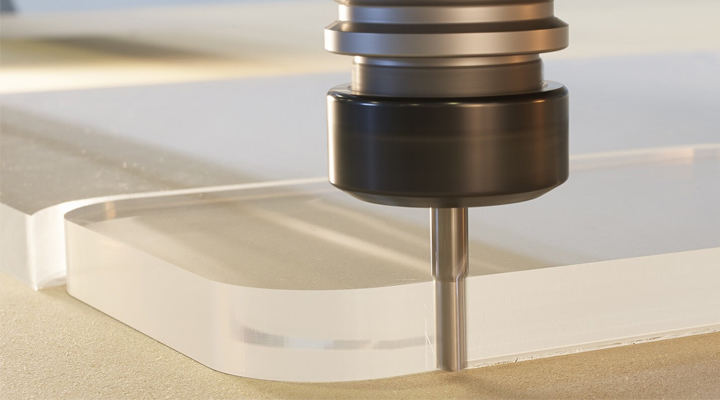
CNC Milling
3-axis, 4-axis, and 5-axis milling for complex acrylic geometries. We use single-flute and O-flute cutters at high RPM with light chip loads to prevent melting and achieve surface finishes under Ra 0.4 µm straight from the machine.

CNC Turning
Lathe work for cylindrical acrylic parts such as lenses, bushings, and light guides. Diamond-tipped tooling produces mirror-like OD surfaces without secondary polishing for diameters up to 300 mm.

Surface Finishing
Flame polishing, vapor polishing (dichloromethane), mechanical buffing, UV curing, spray painting, and dyeing. We select the method based on part geometry, visual requirements, and end-use environment.
Cast vs Extruded Acrylic: Which Grade for CNC?
Not all acrylic sheet is created equal. The manufacturing method determines internal stress levels, molecular weight, and how the material behaves under a cutter. Choosing the wrong grade is the most common cause of cracked parts and gummy tool marks.
Cast Acrylic
Higher cost · Superior machinability
- Higher molecular weight — less brittleness during cutting
- Lower internal stress — minimal risk of crazing
- Higher softening point (~115 °C) — wider cutting parameter window
- Tighter thickness tolerance (±5%) from the supplier
- Better optical clarity and UV stability long-term
- Produces clean chip curls instead of gummy strings
Extruded Acrylic
Lower cost · Narrower process window
- Lower molecular weight — more brittle, chips easily
- Higher internal stress — crazing risk during and after machining
- Lower softening point (~100 °C) — melts at aggressive feeds
- Wider thickness tolerance (±10%)
- Acceptable for non-optical, non-structural parts
- Tends to produce gummy, stringy swarf
Our default: KUSLA machines cast acrylic (Lucite L, Acrylite FF, or equivalent) unless you specify extruded grade. For budget-sensitive, non-optical parts, we can quote extruded stock and adjust parameters accordingly.
Design Guidelines for CNC Acrylic Parts
Acrylic is notch-sensitive and brittle compared to polycarbonate. Following these six rules will prevent cracking, reduce cost, and improve surface quality on your machined PMMA parts.
Minimum Wall Thickness: 1.5 mm
Walls below 1.5 mm flex under cutter pressure and crack. For tall features (height > 4× wall), increase to 2.0 mm minimum.
Internal Corner Radii: ≥ 0.5 mm
Sharp internal corners create stress risers. Specify at least R0.5 mm; R1.0–2.0 mm is preferred. External corners can remain sharp.
Standard Tolerance: ±0.1 mm
Achievable at normal cost. Tighter tolerances (±0.05 mm or ±0.01 mm) are possible but increase machining time and price.
Avoid Direct Threading
Acrylic threads are fragile. Use threaded metal inserts (heat-set or press-fit) or clearance holes with standard fasteners.
Anneal After Machining
Stress relief at 75–85 °C with slow cooling prevents delayed crazing. Essential for parts that will be bonded or exposed to solvents.
Stock Thickness ≥ 2.5× Deepest Feature
Deep pockets in thin stock cause flexing and chatter. Specify stock at least 2.5× the depth of the deepest pocket or slot.
Acrylic (PMMA) Material Properties
Acrylic transmits 92% of visible light through a 3 mm sheet — higher than any other common engineering plastic, including polycarbonate (88%). The table below shows key mechanical and thermal properties relevant to CNC machining.
| Property | Value | ASTM Test |
|---|---|---|
| Density | 1.18 g/cm³ | D792 |
| Tensile Strength | 55–77 MPa (8,000–11,000 psi) | D638 |
| Tensile Modulus | 2,400–3,400 MPa (350,000–500,000 psi) | D638 |
| Elongation at Break | 2–5.5% | D638 |
| Flexural Strength | 83–117 MPa (12,000–17,000 psi) | D790 |
| Rockwell Hardness | M80–M100 | D785 |
| Izod Impact Strength (notched) | 0.3 ft-lb/in (16 J/m) | D256 |
| Glass Transition Temperature | 105–115 °C (221–239 °F) | — |
| Heat Deflection Temperature | 65–100 °C (150–210 °F) at 1.82 MPa | D648 |
| Max Continuous Use Temperature | 65–93 °C (150–200 °F) | — |
| Light Transmission (3 mm) | 92% | D1003 |
| Water Absorption (24h) | 0.3% | D570 |
| Coefficient of Thermal Expansion | 5–9 × 10⁻⁵ in/in/°F (70 µm/m°C) | D696 |
Values are for general-purpose cast PMMA. Specific grades (Lucite, Acrylite, Plexiglas) may vary. Data sourced from ASTM standard datasheets and supplier TDS.
Surface Finishes for CNC Acrylic Parts
The right finish depends on your part's function. Optical components need vapor polishing for uniformity; display cases benefit from mechanical buffing; outdoor signage requires UV-cured coatings for scratch resistance.
Flame Polish
Hydrogen flame melts a micro-layer on edges. Fast, low cost. Best for straight edges and simple curves.
Vapor Polish
Dichloromethane solvent smooths complex surfaces, holes, and threads. Uniform clarity on irregular geometry.
Mechanical Buff
Cutting compound on a cotton wheel. Best for large flat faces and rounded edges on display parts.
UV Curing
Hardens a coating layer with UV light. Adds scratch resistance and chemical resistance for outdoor use.
Dyeing & Painting
Immersion dyeing for translucent color or spray painting for opaque finish. Custom RAL/Pantone matching.
Acrylic vs Polycarbonate: Which Clear Plastic for CNC?
Both are transparent thermoplastics, but they suit different applications. The comparison below helps you decide before requesting a quote.
| Property | Acrylic (PMMA) | Polycarbonate (PC) |
|---|---|---|
| Light Transmission | 92% (highest of any plastic) | 88% |
| Impact Resistance | Low (0.3 ft-lb/in) | High (12–16 ft-lb/in) |
| Scratch Resistance | Good (hard surface, M95) | Poor (scratches easily) |
| UV Resistance | Excellent — no yellowing | Yellows without coating |
| Max Service Temp | 93 °C | 130 °C |
| Machinability | Easy — clean chips | Easy — but stringy chips |
| Cost | Lower | Higher |
| Best For | Lenses, displays, light guides, signage | Guards, shields, high-impact enclosures |
Rule of thumb: choose acrylic when optical clarity and UV stability matter most. Choose polycarbonate when the part must survive impact or operate above 100 °C. Not sure? Send us your CAD file and our engineers will recommend the right material.
Applications for CNC Machined Acrylic Parts
Acrylic's combination of optical clarity, UV stability, and machinability makes it the default material for transparent CNC parts across automotive, medical, lighting, and consumer industries. Common parts we machine include:

Why Choose KUSLA for Acrylic CNC Machining?
We are not a general job shop that happens to cut plastic. Our team has machined thousands of acrylic parts — from 0.5 mm thin-wall light guides for automotive OEMs to 50 mm thick optical blocks for test fixtures. Here is what that experience translates into for your project:
Acrylic-specific tooling library. We stock single-flute O-geometry, diamond-coated, and polished-edge end mills in 15+ diameter increments. The right tool for acrylic is not the same tool you would use on ABS or polycarbonate.
In-house finishing. Flame polishing, vapor polishing, and mechanical buffing happen in the same facility. No outsourcing, no extra lead time, no handling damage between steps.
DFM review on every quote. Before we cut anything, we review your CAD for acrylic-specific risks: sharp internal corners, thin walls, deep pockets, clamping stress points. You get a marked-up DFM report within 24 hours of upload.
ISO 9001:2015 quality system. CMM inspection, batch traceability, and first-article reports available on request.

Frequently Asked Questions
